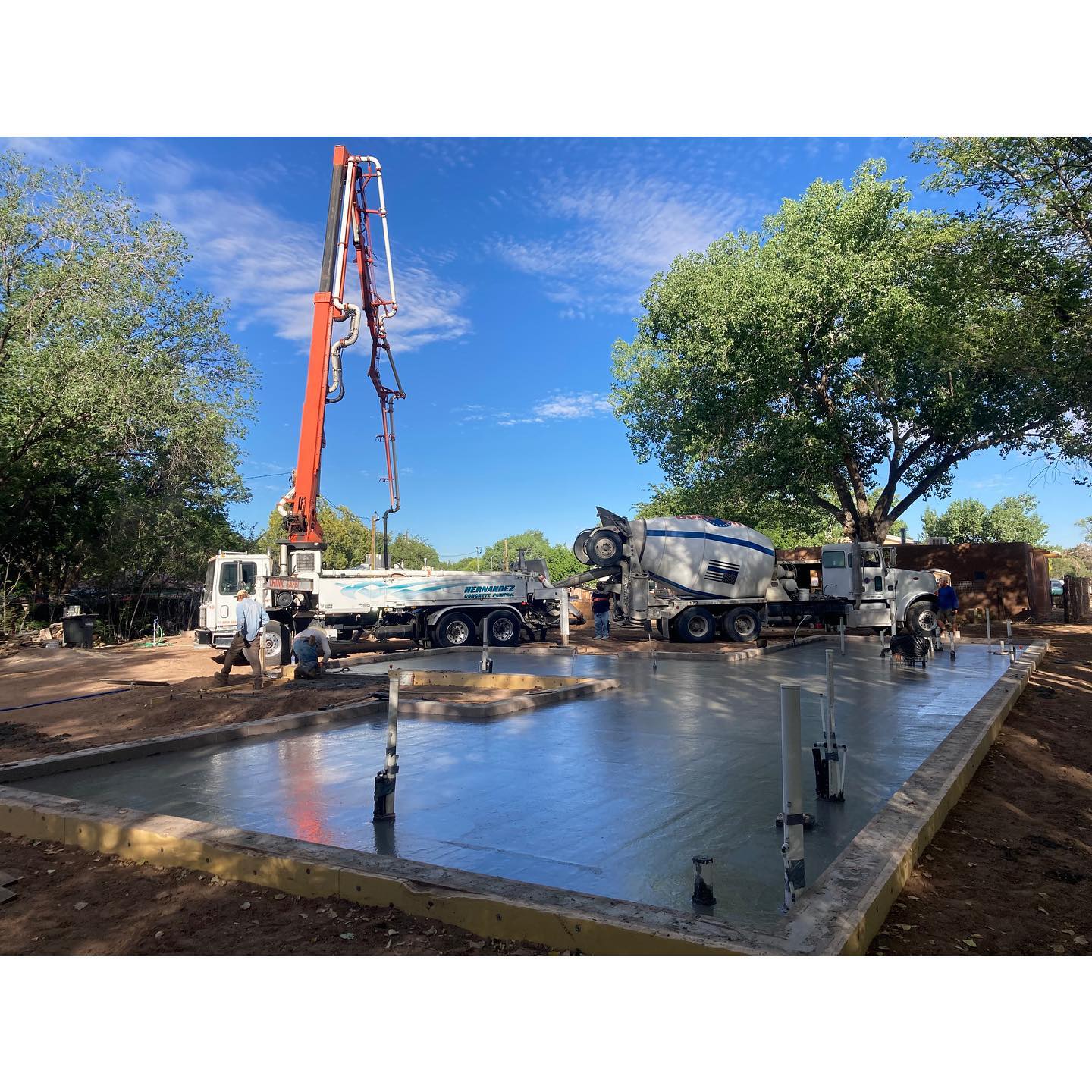
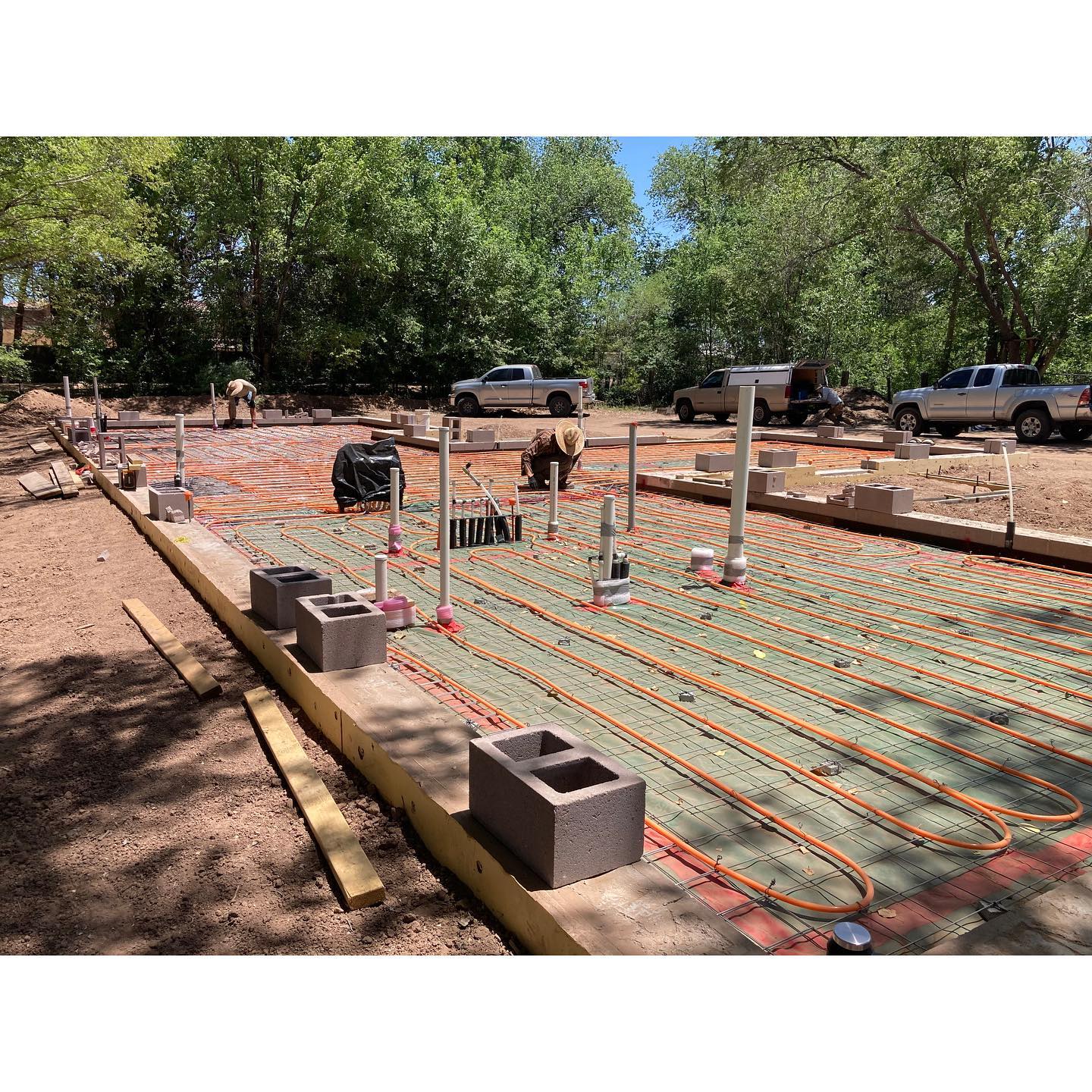
Some thoughts on foundations for adobe structures: Having completed the last stage of our foundations for the two buildings, now seems like an opportune time to reflect a bit on what we’ve wrought. The foundations for the two buildings we’re building now are built like most adobe structures we’ve dealt with–with a traditional or “three-stage” assembly: first you dig footers, then you build a stem wall (either with block or formed concrete), then you pour a concrete slab (or do brick on sand, frame a suspended floor, etc… whichever way you want to build a floor system that fills in between the stem wall. We’re using radiant in-floor heat, so the slab is a good choice for us here). I think we started out using this three-stage method by force of tradition. All the adobe buildings I’d seen during construction used it, and all the books described it as a matter of course. But having done it many times now, and having studied other methods, I’ve come to appreciate how much sense it makes. Here are some of observations: It takes longer than a monolithic slab foundation. In my book, this is not a disadvantage, and it doesn’t necessarily make it more expensive: we’re a small company that does as much in-house as possible, so slow and steady is OK. For us, slower means more accurate, more solid, and less stressful. Not that monolithic foundations can’t be flat and square, but I think it’s easier and more reliable to get a block stem wall to exact dimensions and elevation than a bunch of squirrely 2×6 form boards nailed to the ground everywhere. You set the block, check the block, fill the block, and can be sure beyond any doubt that it will be correct tomorrow, too. By correct, I generally mean within ¼” of square across the entire building, and ⅛” or less in plane. It might seem odd to fuss over such small details when the whole house is just built of mud anyway, but a mistake at this stage will haunt you till the very end. The adobes don’t care whether they’re laid in a square building or not, but everything else does.
If you’ve ever seen a monoslab all dug out and “ready” to be poured, you can’t help but notice all the fluffy dirt everywhere. I don’t like to see that, and with a stem wall, we always have solid containment around the fill that will support interior grade beams and the floor. So, it is easy to do a really good job with compaction. If we feel that the dirt on site won’t compact well, we bring in quality fill dirt for the building pads. Another nice benefit of using this method is that we use less concrete. Whether your concern is CO2 or just $$$, using concrete wisely just makes sense. I’ve long said that for what it is, concrete is ridiculously cheap. But at $185 a yard, that is feeling less and less true. Nice, carefully dug trenches and a well-graded slab substrate mean it is easier to order the correct amount of mud, so there’s less waste, and you’re not wasting money on filling a bunch of wonky shapes with expensive material. #adobeconstruction #adobebuilding #buildingfoundation #slab #stemwall #adobebuilder #adobes #customhome #masonryconstruction
Jun 29, 2023
 abqjoinery.com